





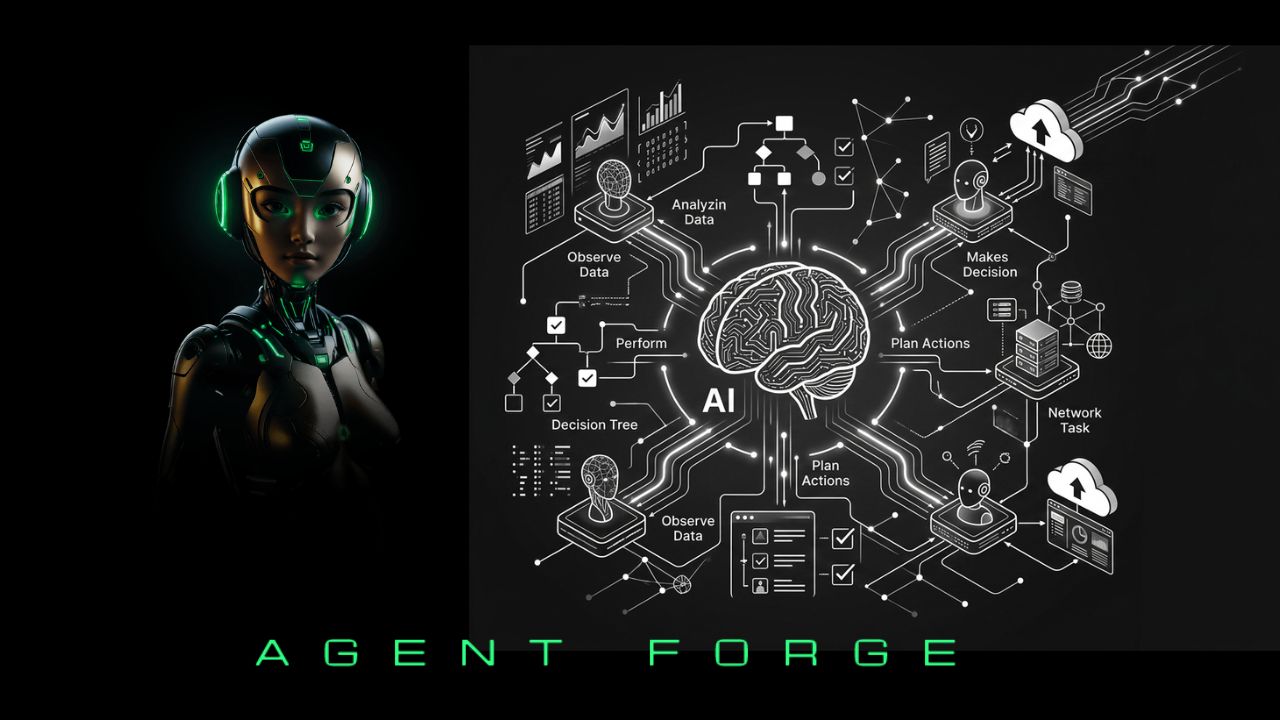
A few years ago, the tech world was obsessed with artificial intelligence that could answer questions, write essays, and generate images. We marveled at AI replies and chatbots. Today, however, we are quietly shifting from AI that simply replies to AI that generates workflows. Let’s all give a big round of applause to the era of Agentic AI.
Let’s take it this way, if traditional AI is a highly intelligent consultant that recommends and guides you, then Agentic AI is the multitasking employee who not only takes the recommendation but logs in to your software create a workflow, and adjusts their strategy to get the ultimate result.
In this modern world, understanding what Agentic AI is and how we can incorporate it into our daily lives as a business leader, developer, tech enthusiast, freelancer, or even for an office worker is more than just an option it is the ultimate baseline for the next decade of enterprise innovation.
Keeping this in mind, this comprehensive guide breaks down the mechanics of Autonomous AI Agents, explores how LLM-based Agents make complex decisions, and reveals the strategies that most organizations are currently missing.
What is Agentic AI?
Agentic AI refers to artificial intelligence systems that act independently to achieve the goals that were once predefined. These systems do not require a human to prompt the workflow at every step. They can perceive their environment, reason complex problems, make strategic decisions, and execute actions across all or required ecosystems using external tools.
To truly grasp this shift, we have to look at how AI has evolved:
- Traditional AI: Rule-based and reactive. (e.g., If a customer clicks X, send email Y.)
- Generative AI: Conversational and creative, but passive. (e.g., Write me a draft of email Y.)
- Agentic AI: Autonomous and proactive. (e.g., Identify clients who haven’t engaged in 30 days, draft a personalized email based on their purchase history, send it via HubSpot, and notify me on Slack if they reply.)
This leap turns AI from a simple software application into dynamic AI Decision-Making Systems capable of handling end-to-end workflows.
The Architecture: How Autonomous AI Agents Work
According to some resources, AI agents simply do things and perform tasks, but the question is, how do they strategise complex decisions without human intervention?
This happens through a continuous loop of 5 core functions. Let’s discuss them in detail.
1. Perception (Gathering Context)
Before an agent carries out the workflow, it needs to understand its environment. Autonomous AI Agents use integrations, sensors, APIs, and document parsers to ingest real-time data. From reading a customer support ticket to scanning inventory databases, even checking the weather conditions for a supply chain route, the AI Agent pulls up unstructured and structured data for proper strategic compliance.
2. Reasoning (The “Brain”)
This is where LLM-based Agents shine. A Large Language Model like GPT-4, Claude, or Gemini serves as the cognitive engine. The AI studies the data it has just perceived, understands the context goals, and forms a strategy. These agents break down large, ambiguous goals into much smaller sub-tasks that are achievable and executable.
3. Memory (Context Retention)
One of the major gaps in early AI was its “goldfish memory” or low memory retention. Now Agentic AI relies on two types of memory:
- Short-term memory: This keeps track of the current conversation or ongoing task execution.
- Long-term memory: This is powered by vector databases and allows AI to recall past conversations, historical data, and successful strategies that were interacted with months ago. This is the foundation of Self-Learning AI Systems.
4. Action (Using Tools)
An AI brain is useless without hands. Agentic systems are equipped with “tools” which are essentially API connections to third-party software. An AI agent can run a Python script, query a SQL database, send an email, or update a Salesforce record.
5. Reflection (Continuous Learning)
Once the action is taken, AI agents evaluate the outcome. It analyzes the outcomes to determine if the code has run successfully or if an error occurs, it reads the error log, adjusts its approach, and tries again to attain the aligned goal. Agentic AI doesn’t crash.
Agentic AI vs. AI Agents: Is There a Difference?
While often used interchangeably, there is a subtle structural difference that many businesses miss when planning their AI strategies.
- An AI Agent is a single, localized entity designed to perform a specific task (e.g., an agent strictly built to monitor network security anomalies).
- Agentic AI refers to the broader, orchestrated ecosystem. It often involves Multi-Agent Systems where different highly specialized agents collaborate.
Think of it this way: An AI agent is a brilliant individual worker. Agentic AI is the entire corporate department, complete with worker agents, an orchestrator (manager) agent, and a reviewer (QA) agent, all communicating seamlessly to finish a massive project.
The Business Value: Why Agentic AI is a Trillion-Dollar Shift
Top institutions like MIT Sloan and leading cloud providers (AWS, Google Cloud) are projecting Agentic AI to be a multi-trillion-dollar economic force. But why?
1. Zero Marginal Cost for High-Stakes Decisions
Not so long ago, hiring multiple individuals to handle complex cognitive tasks like reviewing legal contracts, underwriting loans, or planning logistics was the only means to expand a company’s output. But with Autonomous agents, we can execute these multi-step workflows 24/7 without fatigue, drastically reducing transaction costs.
2. Hyper-Specialized Collaboration
In a Multi-Agent architecture, you can have a “Research Agent” search and crawl the web for data, then a “Data Scientist Agent” will run statistical models on that collected data, so that a “Copywriter Agent” formats the findings into a report. This collaboration between multi-agent architectures can achieve domain-specific performance that can not be matched by many basic SaaS platforms.
3. Proactive Problem Solving
Agentic AI can track and monitor server loads, pre-predict failures, autonomously reroute traffic to healthy servers, and generate a post-mortem report for the IT team instead of waiting for the system to trigger an alert.
Real-World Applications You Can Implement Today
The transition from theory to practice is already happening across various sectors:
- Software Engineering: Tools like Devin or customized LLM pipelines aren’t just autocompleting code; they are planning architectures, hunting down bugs across repositories, and deploying fixes entirely on their own.
- Supply Chain Optimization: These agents can continuously monitor global weather, geopolitical news, and port traffic and autonomously reroute cargo ships to avoid delays.
- Next-Gen Customer Support: With the help of an AI agent, looking up a user’s lost package, negotiating a refund, updating the CRM, and emailing a personalized apology becomes easy. And it loops in a human only if the customer remains unsatisfied.
What Most Companies Miss About Implementation
Yes, absolutely, Agentic AI is great. However, it is relevant to know the reality of implementation. Here are some critical factors you must consider to ensure that your AI doesn’t go rogue.
- Data Structuring is 80% of the Work: You cannot plug an AI agent into a messy digital environment. For LLMs to retrieve and act on data efficiently, your internal data must be clean, vectorized, and accessible via robust APIs.
- The “Personality” of AI Agents: Surprisingly, research shows that multi-agent systems perform better when given distinct “personas” (e.g., making one agent highly analytical and critical, and another creative). This dynamic prevents the AI echo chamber and yields better problem-solving.
- Human-in-the-Loop (HITL) Governance: You should not give an AI agent a corporate credit card or delete permissions on day one. Establish gating mechanisms where the AI plans a workflow, but a human must click “Approve” before execution. Over time, as the AI proves its reliability, you can widen its autonomous leash.
The Future of Self-Learning AI Systems
We are standing at the precipice of a new digital workforce. As reinforcement learning techniques (like Proximal Policy Optimization) improve, Self-Learning AI Systems will require less manual prompting and fewer rigid API structures. They will learn to navigate the web and enterprise software exactly like humans do by looking at a screen and inferring where to click.
For businesses and enterprise industries, the vision is clear. Adopting AI Decision-Making Systems to automate multi-step workflows will help them operate at a speed that traditional companies are lacking behind on.
Ready to build your autonomous AI workforce? Explore more cutting-edge AI insights, tutorials, and enterprise solutions at AITech.io today. Let’s build the future, autonomously.
FAQs
-
What is agentic AI and how does it work?
Agentic AI refers to artificial intelligence systems that act independently to achieve the goals that were once predefined.
-
What is agentic AI vs autonomous AI?
Agentic AI bridges the gap by introducing planning, learning, and context-aware adaptability for more dynamic goal achievement, whereas Autonomous AI has complete independence and is capable of decision-making and long-term planning with minimal human oversight.
-
What is the difference between agentic AI and AI agents?
Essentially, Agentic AI is the broader concept of solving issues with limited human supervision, whereas an AI agent is a specific component within that system that is designed to handle tasks and processes with some or total degree of autonomy.
-
What is an autonomous agent in AI?
An autonomous agent is an advanced form of AI that can understand and respond to inquiries, then take action without the supervision of any human.


