




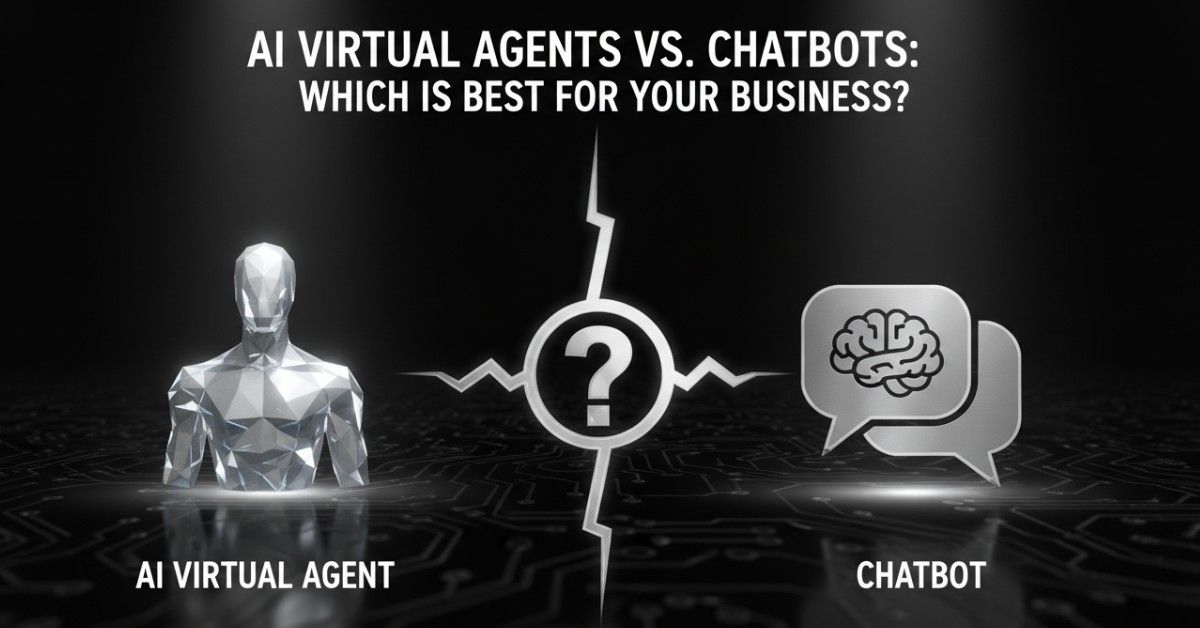
The difference between an AI virtual agent and a chatbot is their ability to understand intent. Chatbots basically follow pre-set rules and offer limited answers. In contrast, AI virtual agents use advanced NLP to manage complex tasks, remember past conversations, and solve problems without human help. Choosing an AI virtual agent is basically better for companies looking to automate full customer journeys, not just because of answering simple FAQs.
The Evolution of Customer Support
Customer service has moved far beyond basic phone calls. For so many years, companies used basic scripts to talk to customers virtually. These early tools saved time but mostly left users frustrated because they could not handle unexpected questions.
Today’s technology comes along with machines that think more like humans. We are seeing a shift from “answering” to “doing.” This change helps companies stay competitive by providing instant help around the clock.
What Is an AI Virtual Agent?
An AI virtual agent is a software program designed to act as a digital employee. Unlike basic tools, these agents use NLP to understand the “why” behind a customer’s question. They don’t just look for keywords; they understand context.
These virtual assistants can connect to your internal systems. That means they can check order statuses, process the refunds, or update account details. They may have a high-level service that feels personal and professional.
Understanding the Traditional Chatbot (AI Virtual Agents vs Chatbots)
While businesses combine traditional chatbots with advanced AI virtual agents, there are distinct differences in their functioning and the value they provide. Although both aim to automate customer interactions, their capabilities differ significantly.
| Traditional Chatbot | AI Virtual Agent |
| Rule-based responses | AI-driven, context-aware responses |
| Limited to scripted flows | Handles dynamic conversations |
| No learning capability | Learns and improves over time |
| Minimal personalization | Personalised user interactions |
| Limited integrations | Deep system and CRM integration |
Traditional chatbots are designed for simple, rule-based tasks, whereas AI virtual agents provide smarter, more flexible, and personalised automation for modern businesses.
Chatbot vs AI Assistant: Key Technical Differences
A chatbot and an AI assistant can make it just on the surface, but maybe technically they’re built for very different levels of capability, context, and system integration.
- Scope: Chatbots are able to manage the already defined flows, such as FAQs and customer support. AI assistants can handle tasks involving multiple steps.
- Conversation logic: Chatbots also deal with intent-based queries; assistants, however, rely upon LLM tools.
- Context handling: Chatbots enable restricted session context; assistants maintain longer context and can use memory/state.
- Tool use: Chatbots mostly don’t take action themselves, whereas AI assistants can call APIs, search systems, write files, schedule, and automate their workflows.
- Knowledge access: Chatbots, however static scripts/KBs; AI assistants, on the other hand, can use retrieval (RAG), real-time data sources and databases.
- Personalisation: Chatbots are generic; assistants can adapt responses based on user role, history, and user preferences, ultimately.
- Output quality: Chatbots are consistent but very simple; assistants produce better responses, summaries, and action-ready outputs.
Chatbots answer questions, and AI assistants complete tasks by combining conversation, context, and integrations.
How AI Conversational Agents Handle Complex Tasks
AI conversational AI platforms do more than just simple talk. They surely use tools like ChatGPT to generate human-like responses and solve multi-step problems. For instance, an agent can help a customer book a flight, choose a seat, and process the payment in one go.
This is possible because they integrate with your existing software. Aitech.io offers the high-performance infrastructure needed to power these difficult interactions. These agents handle the “grunt work”, so your human team can focus on big-picture strategy.
Benefits of AI Customer Support Automation
AI customer support automation helps businesses respond faster, reduce workload, and improve overall customer satisfaction. By automating routine queries and support tasks, companies can deliver consistent service while saving time and resources.
Key Benefits:
- 24/7 customer support availability
- Faster response times
- Reduced operational costs
- Consistent and accurate answers
- Handles a high volume of queries
- Improves customer satisfaction
- Frees up human agents for complex issues
- Real-time data and insights
AI customer support automation not only updates efficiency but also improves the complete customer experience, helping businesses grow smarter and faster.
Choosing the Right Solution for Your Business
If your main goal is only to answer “What is your phone number?”a basic chatbot is enough. However, if you want to grow, you require intelligent virtual assistants. Look at your current support tickets. If most of them require a human to look up data, an AI agent is the better investment.
Start by mapping out your basic client journeys. If these journeys involve multiple steps or data changes, go with a full AI solution. It will save you time and money in the long run.
Conclusion
AI virtual agents can go beyond basic chatbots by combining conversation with reasoning, memory, and action-taking abilities. Whereas chatbots are best for simple FAQs and can bring the scripted flows, virtual agents can handle multi-step requests, connect to the company’s systems, and complete tasks end-to-end, such as updating records, scheduling, or resolving support issues with minimal human help.
- Upgrade to AI virtual agents for smarter automation and better customer engagement.
FAQs
1. What is the difference between an AI virtual agent and a chatbot?
A chatbot has the rules and scripts to answer simple questions. An AI virtual agent uses NLP to understand context, solve complex problems, and perform tasks like a human employee.
2. What are intelligent virtual assistants?
They are AI programs that can manage human-like conversations and merge them with business systems. They are also used for tasks like scheduling, data entry, and personalised customer support.
3. How does AI customer support automation save money?
It minimises the ultimate need for large support teams by managing most of the customer questions instantly. This lowers operational costs also.
4. What is a chatbot vs an AI assistant comparison?
A chatbot is one of the positive tools for basic FAQs. An AI assistant is a smart tool that learns from the users, remembers conversation history, and can also complete transactions without any help.
5. How do AI conversational agents work?
They use tools like ChatGPT and machine learning to analyse text and voice. They break down a user’s request to find the intent and use more connected databases to offer a helpful answer.
6. Can I use an AI virtual agent for my small business?
Yes. Modern AI tools are scalable. You can first use a small agent for specific tasks and grow it as your business expands. It is a great way to provide 24/7 service without hiring more staff.


