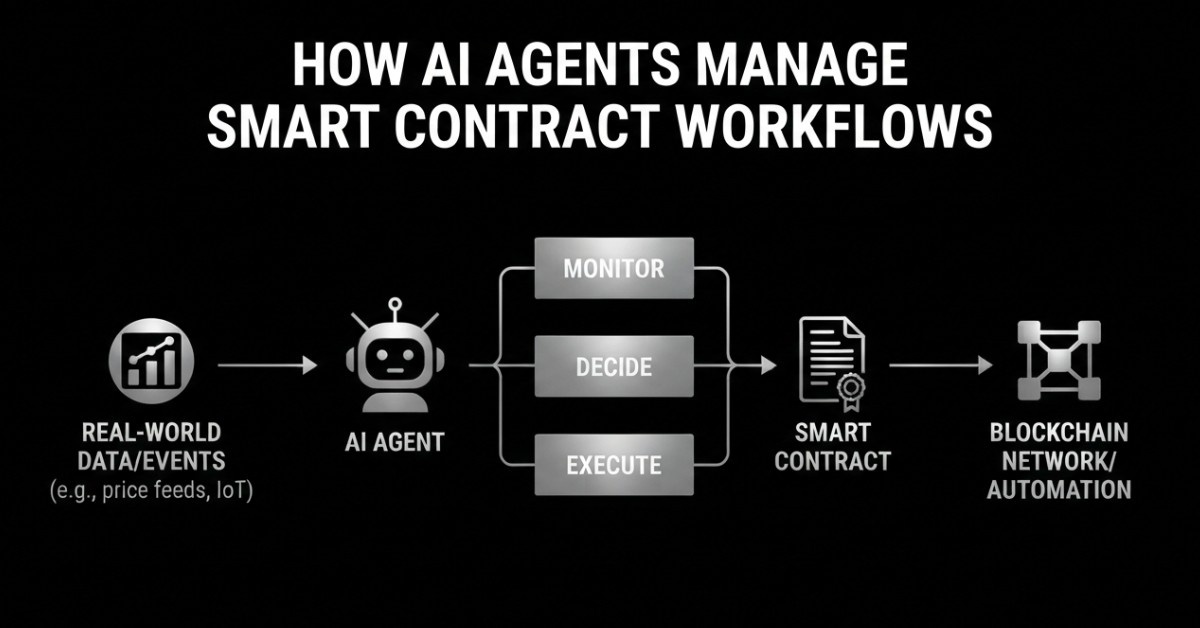


How AI Agents Manage Smart Contract Workflows
Traditional smart contracts are not flexible because they can't keep track of changing real-world situations on their own. This problem is why AI agents for smart contract workflows are becoming an important part of the system. By constantly analyzing external data feeds and wallet activity, these intelligent agents turn reactive code into dynamic systems, finally unlocking authentic, high-speed automation across decentralized networks.
What's Actually Changing in Smart Contract Automation
For a long time, the "smart" part of smart contracts was not very advanced. A contract could run code, but it was mostly a fixed tool that could only respond to things happening inside it. It couldn't observe or keep track of what was happening outside. This created a reliance on manual intervention.
- The Old Way: Developers or DAO members had to manually trigger contract functions, leading to bottlenecks and latency.
- The New Way: Autonomous agents watch live data prices, events, or wallet activity and fire the contract the instant it’s needed.
- The Result: The agent becomes the "smart" layer, transforming rigid code into a responsive, living system.
Basically, the contract stopped being the smart part of the agent. Smart contract automation allows businesses to eliminate the middleman.
How AI Agents and Smart Contracts Work Together
When discussing the role of AI in smart contracts, it is not to be taken that the AI becomes the smart contract. Rather, the agent acts as the conductor, ensuring the proper execution of the code based on external factors.
Where AITECH Cloud Network Fits In
The biggest challenge for using agentic blockchain is having the right infrastructure. Most development teams take a lot of time to write complicated code for triggers just to make a basic agent work. This uses up resources and slows down how quickly they can introduce their product.
- Infrastructure: We offer a strong system that lets agents work with smart contracts safely and dependably.
- Reliability: We remove the need for manual coding of every trigger, allowing your team to concentrate on business tasks instead of technical details.
- Scalability: Our high-performance computing environment ensures your blockchain workflow automation remains secure as transaction volumes grow.
Real Use Cases: Payments, Monitoring, Compliance
Blockchain workflow automation is already being adopted in industries that require ultra-fast and accurate processing. Companies are using these platforms to streamline activities that would otherwise be time-consuming and expensive, or at risk of human error.
- Automated Payment Release: Initiating escrow payments automatically once off-chain delivery goals are confirmed using IoT or trackers.
- Compliance Checks: Performing automated identity and risk assessments before completing transactions on-chain.
- Treasury Rebalancing: Changing liquidity pools or transferring company assets depending on market fluctuations without any manual approval.
Risks Nobody Talks About Enough
As these systems function independently, it is important to state their pros and cons. If an agent receives incorrect data, it is going to make a wrong decision very fast. We think being open about risks helps build trust for a long time.
- Data Integrity: Agents can only do a good job if they have good data to work with; bad data results in bad performance.
- Circuit Breakers: We always recommend implementing safety parameters for any AI-powered smart contracts to ensure they operate within your risk limits.
- Security: As with any blockchain interaction, testing the agent’s logic in a sandbox environment is non-negotiable.
Getting Started with AITECH Cloud Network
You don't need a massive team to start building. Getting started is a straightforward process when you have the right infrastructure in place to support your agent's unique needs. We provide the tools to help you bridge the gap between traditional business processes and on-chain efficiency.
- Digital Wallet: Ensure you have a secure, enterprise-grade wallet ready for transaction signing.
- Workflow Definition: Clearly map out the logic-based steps your agent needs to execute.
- Monitoring Tools: Set up basic dashboards to track your agent’s activity, health, and success rates.
Talk to the AITECH Cloud Network team →
Conclusion
Integrating autonomous agents into your blockchain architecture is an operational necessity. By leveraging AITECH Cloud Network’s infrastructure, you maximize efficiency while maintaining strict governance control. Start building your automated future today by streamlining your workflows with the intelligence, speed, and security that modern digital markets demand.
AITECH Cloud Network empowers your business with scalable, secure infrastructure, automating complex smart contract workflows with unparalleled speed.
FAQs
1. How do AI agents manage smart contract workflows?
Agents monitor data, apply logic, and automatically execute contract functions based on real-time triggers.
2. What role do AI agents play in smart contract automation?
They become the “smart” layer that turns reactive/static code into a responsive/autonomous system.
3. How can AI improve blockchain workflow management?
By eliminating manual steps, decreasing latency, and conducting multi-stage operations without human interaction.
4. What are the benefits of using AI with smart contracts?
Faster processes, greater accuracy, lower costs, and an absence of errors in transactions.
5. Can AI agents automate decentralized applications?
Yes, agents track on-chain and off-chain data and automatically run logic and functions of the DApp.
6. How do AI agents enhance the efficiency of smart contract execution?
By replacing manual and slow triggers with instantaneous execution when certain conditions have been met.


344.svg)