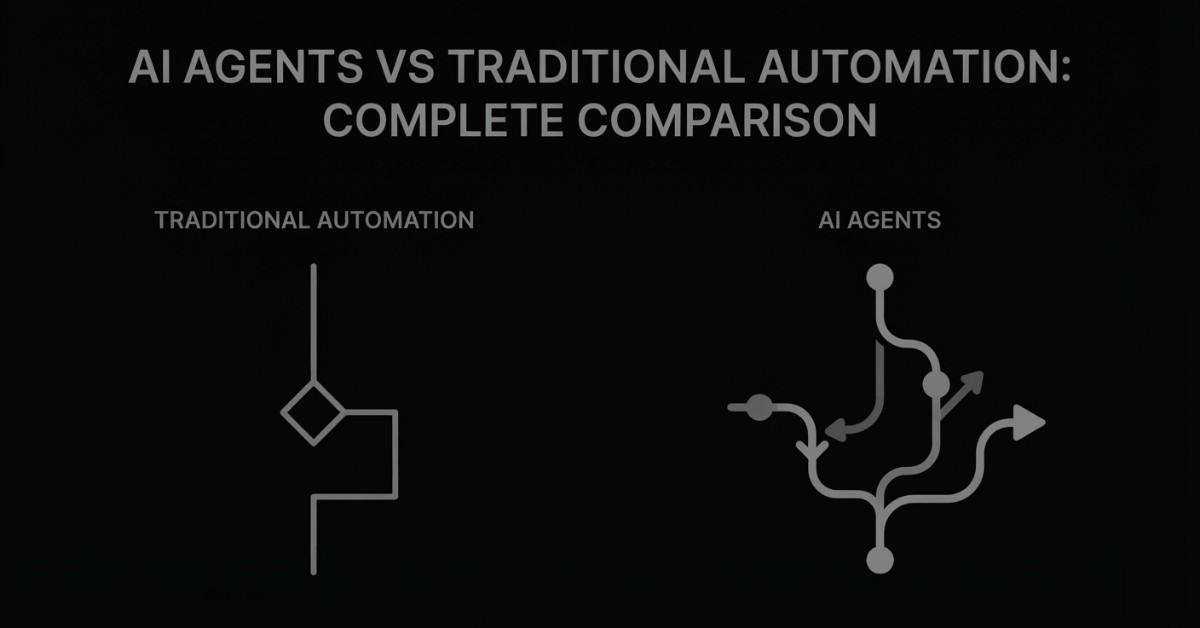


AI Agents vs Traditional Automation: Complete Comparison
Understanding the distinction between AI agents and traditional software automation is the single most urgent decision facing operations and engineering leaders this year. While legacy deterministic scripts reliably execute fixed rules across structured data, autonomous AI agents leverage language models to reason, adapt, and process unstructured inputs dynamically. Balancing both paradigms allows modern enterprise teams to optimize workflow agility, maintain execution speed, and control GPU compute expenditure.
Why This Comparison Matters
Large language models have moved agentic workflows out of research labs and straight into core enterprise operations. Teams that built their architectures on rigid scripts now realize that faster code cannot resolve unstructured human inputs or fluctuating data formats.
- Legacy Limitations: Platforms built on RPA or Zapier break when faced with non-standard input formats.
- Cost Efficiency: Replacing every simple script with an LLM loop creates unnecessary compute expenses.
- Modern Architecture: Modern enterprise stacks combine raw data processing on the AITECH Cloud Network’s Compute Marketplace with orchestration via Agent Forge.
Quick Comparison: AI Agents vs Traditional Software Automation at a Glance
Comparing AI agents and traditional software automation side by side reveals their unique strengths in various aspects of contemporary enterprise activities.
What Is Traditional Software Automation?
Automation of deterministic traditional software follows a series of fixed rule sets by use of RPA bots, scheduled scripts, webhooks, and workflow integrations.
- Core Function: Moves data from one digital system to another in accordance with predefined conditional logic.
- Common Use Cases: Automatic invoice follow-ups, scheduled database backups, customer relationship management records synchronization, and routine approvals.
- Key Strengths: Very high execution speeds, complete reliability, cheap computing, and easy auditing.
- Primary Limitation: Extreme fragility; even a minor change in input layout halts execution and requires manual developer updates.
What Are AI Agents?
Autonomous AI agents are smart software programs that have goals. They use big language models to understand their surroundings, make detailed plans, and carry out tasks using different tools.
- Core Mechanics: Understand messy information, choose the right digital tools using APIs, and keep improving until goals are met.
- Primary Use Cases: Helping customers, reading large documents, doing research automatically, and assisting internal teams.
- Multi-Agent Orchestration: Special agents split up complicated tasks, working together smoothly using platforms like Agent Forge.
- Operational Value: Replaces manual triage and human evaluation on tasks with high input variation.
AI Agents vs Traditional Software Automation: Key Differences
A direct comparison of AI agents vs traditional software automation leads to three main structural differences:
- Rules vs Goals: With software automation, there are pre-coded rules such as "If X then Y." An AI agent is assigned a goal and determines how to achieve it.
- Deterministic Vs Probabilistic: Standard software automation gives identical output when input A occurs. AI agents evaluate contextual nuances probabilistically to resolve complex requests.
- Compute Requirements: Standard scripts run easily on lightweight web servers. AI agents demand dedicated GPU compute and dedicated orchestration layers to manage real-time inference.
Where Traditional Automation Still Wins
Despite rapid AI advances, traditional software automation remains superior for rules-stable operations. Tasks such as regular database backups, syncing customer information, automatic billing, and tracking time for service agreements don’t require any complex thinking. Using AI models in these processes brings extra costs, delays, and risks related to following rules. When rules are static, standard software automation offers unmatched speed and predictable low costs.
Where AI Agents for Business Automation Outperform
Using AI agents for business automation offers clear advantages when workflows involve heavy variation or unstructured text. Primary use cases include:
- Customer Support Triage: Grouping complicated user problems and starting the right actions behind the scenes.
- Document Processing: Pulling out important parts and potential risks from contracts that aren’t neatly organized.
- Multi-Agent Operations: Routing tasks between classification, retrieval, and drafting agents before final human approval.
Verdict: Best applied where human judgment, not raw task execution, creates the operational bottleneck.
Real Cost & ROI: Rules-Based vs Agent-Based Systems
Comparing financial returns between legacy rules and dynamic AI agents requires evaluating both compute infrastructure and maintenance overhead.
How to Deploy AI Agents Without Replacing Your Existing Stack
You don’t have to get rid of old systems to use smart technology. Today’s systems combine AI helpers and regular software automation into one system.
- Map Your Workflow: Review the current steps and identify tasks that follow a clear pattern versus those that require personal judgment.
- Keep Core Scripts Intact: Let the reliable software continue working for writing to the database and moving data on a schedule.
- Pilot Narrow Agents: Create an AI program that helps with specific tasks, like organizing messy emails or checking contract details.
- Bridge via Orchestration APIs: Connect agents to current databases using Orchestration APIs with Agent Forge to control how things work and keep everything safe.
Conclusion
Today’s operations can utilize both AI agents and regular automation simultaneously. The strongest business systems use two things: clear scripts for tasks that follow specific rules and AI tools for more flexible problem-solving. Using this mixed approach helps the organization be flexible, control computing costs, and increase long-term returns on investment.
FAQs
1. What is the difference between AI agents and traditional software automation?
Traditional automation executes fixed, rule-based scripts, whereas AI agents reason dynamically to adapt to unstructured inputs.
2. Which is better for business workflows: AI agents or traditional automation?
Neither is universally superior; combining deterministic execution with agentic reasoning delivers the highest operational efficiency and ROI.
3. What are the benefits of AI agents over traditional software automation?
AI agents process unstructured data, resolve edge cases autonomously, and dynamically adapt multi-step plans to achieve goals.
4. When should businesses use traditional software automation?
Use traditional automation for high-speed, predictable, rules-based tasks like scheduled backups, billing cycles, and API record syncs.
5. Can AI agents and traditional automation work together?
Yes, modern enterprise stacks use traditional scripts for deterministic execution and AI agents for contextual interpretation.


344.svg)