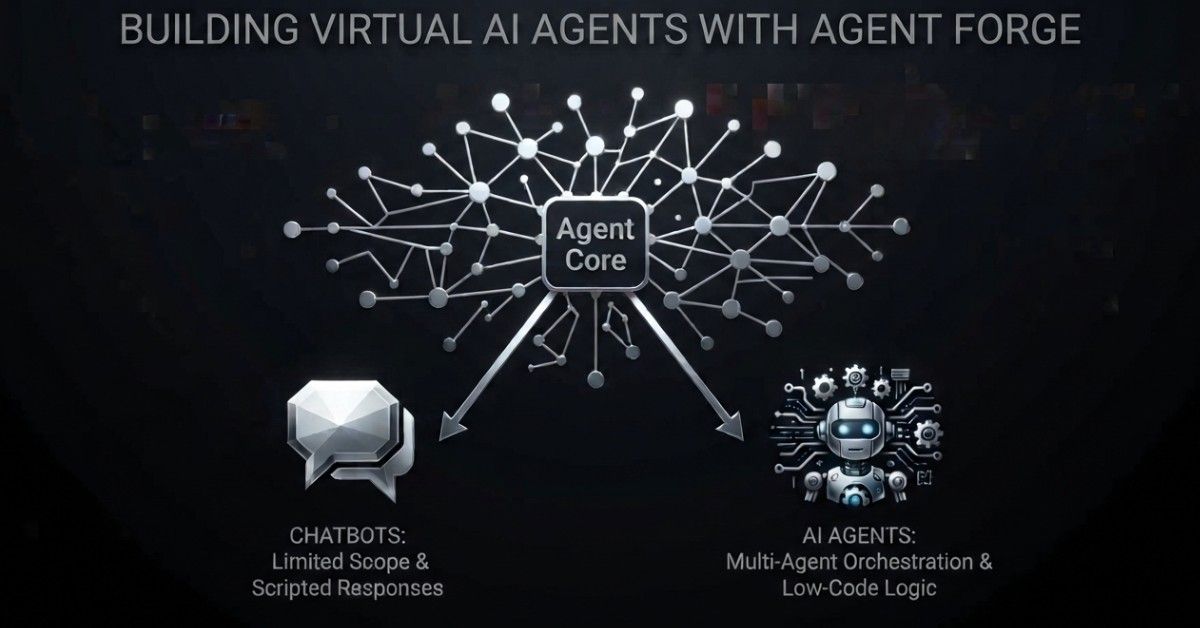


Building Virtual AI Agents With Agent Forge
You may have been hearing the term AI agents everywhere. Be it in the news, from your tech team, or maybe from your competitors, we already know that AI has moved on from being a tool that simply answers questions to planning, deciding, and executing tasks on your behalf. As everyone is prompting ChatGPT for ideas, the real techies are building AI agents.
If you’re also one of them and want to know how to create AI agents, this blog is for you. Read the blog further as we’ll walk you through what AI agents are, how they’re different from the other tools, and how they actually work.
What are AI Agents and Agent Forge
An AI agent is a software program that uses AI to achieve specific goals. The AI agent can break a goal into steps, make decisions, and interact with other tools to get the job done. This process follows the core architecture used by autonomous AI agents.
Here’s a simple analogy. You hire someone who never sleeps and never needs to be told the same thing again. You give them a goal and they achieve it.
AI agents are different from other software in a way that they can handle situations well that weren't programmed. This lets you hand off entire workflows. IBM research found that organisations who deploy these AI agents are seeing measurable gains in operational efficiency.
Agent Forge, AITECH Cloud Network's agentic AI platform, is a low-code builder for building and deploying autonomous AI agents. This makes them capable of reasoning, executing multi-step workflows, and acting across your existing tools and data sources, all without requiring a development team to write and maintain code.
Key Features of Agent Forge for Virtual AI Agent Development
As mentioned before, Agent Forge is a low-code platform designed to build and deploy autonomous multi-agent AI systems. Here are some of its key features for virtual AI agent development.
- Multi-agent orchestration, so you can run hundreds of AI agents simultaneously across departments, each executing its own role toward the same outcome.
- A visual, low-code builder that lets you configure complex agent logic and sequencing without writing code.
- Real-time monitoring through a unified dashboard, giving you full visibility into every agent, action, and decision.
- Native integrations with the tools you already use, including CRMs, ERPs, and communication platforms, so agents plug into your existing stack without disruption.
- Enterprise-grade security, with cloud-native infrastructure and end-to-end encryption built in from the ground up.
Difference Between AI Agents vs Chatbots vs Automation Tools
The terms mentioned above are often used interchangeably. They are different things, and here’s a clear breakdown:
Chatbots
A chatbot, in easy terms, responds to what you say by following a fixed script within a limited scope. It waits for your commands and then responds. The major drawback is that they can’t take action on their own and make decisions.
Automation Tools (like n8n)
Automation tools such as n8n connect your apps and perform actions based on the rules you define. They are the very best at handling predictable and repeatable tasks. The only drawback is that they follow fixed logic and don't think.
AI agents
AI agents are working towards an outcome and bring the best of both worlds. They reason, make judgment calls, and use multiple tools at once. To make it simple for you, always remember this: chatbots only talk. Automation only follows rules. But AI agents both think and act.
The table below provides a useful comparison:
How to Build an AI Agent from Scratch: Step by Step
Creating AI agents is now easier and more achievable than before. It is made up of four components, including a brain (the LLM), a memory system, a set of tools, and a reasoning loop. Here’s the step-by-step process.
Step 1: Define the Agent's Goal and Scope
The first step is defining what your agent is supposed to do. For example, you must know what problem it will solve, whom it will serve, etc. An AI agent without clear boundaries often produces generic responses.
Step 2: Choose the Right Large Language Model (LLM)
An AI agent needs a large language model. For instance, a customer-facing support agent that needs fast responses has different requirements than an internal research agent handling complex reasoning. Common choices include GPT-4, Google Gemini, or Llama. This is an important step before deploying.
Step 3: Design the Logic and Decision Flow
Now start by mapping out what triggers the agent, then define how it moves through a conversation or task. AI agent builder platforms such as Agent Forge’s low-code builder let you design the decision branches clearly.
Step 4: Connect Tools, APIs, and Knowledge Bases
In this step, define what your agent knows and what it can do. Simply connect it to your CRM or third-party services. You'll also configure memory here.
Step 5: Test, Break, and Refine
Use Agent Forge to simulate real conversations and workflows before going live. Deliberately try to confuse the agent: give it incomplete inputs, contradictory instructions, and out-of-scope queries.
Step 6: Deploy, Monitor, and Improve
Once you are done testing, Agent Forge makes deployment easy, and your agent will be published. Also use the real-time monitoring dashboard to track response quality, failure rates, and latency from day one.
AITECH Cloud Network: Your Trusted Partner for AI Infrastructure
Building intelligent agents is only half the equation. Where to build and how to run them matters more. AITECH Cloud Network provides the cloud infrastructure, security architecture, and deployment environment that virtual AI agents need to perform reliably at scale.
Ready to power your AI agents with infrastructure that keeps up? Explore AITECH Cloud Network.
Summing Up
This blog post clearly explains the steps of building AI agents. It is obvious that only the largest companies in the world could afford to build such an agent long ago. Now the time has changed. Today, platforms like Agent Forge make it possible to build and deploy AI agents quickly, often with little or no coding required.
The businesses investing in agentic AI today are building an advantage that will only grow over time.
FAQs
1. What is Agent Forge and how does it help build virtual AI agents?
Agent Forge is an AI agent builder platform that lets developers and businesses design, build, and deploy intelligent agents through a low-code visual interface.
2. How do I create an AI agent using Agent Forge?
Define your agent's goal, map the logic flow, connect your tools and data, test it, then deploy.
3. What features does Agent Forge offer for AI agent development?
Key features include a low-code visual builder, multi-agent orchestration, native integrations with CRMs and ERPs, and a real-time monitoring dashboard.
4. Can businesses build custom AI agents with Agent Forge?
Yes. Agent Forge supports fully custom virtual AI agent development with enterprise-grade security.
5. What are the benefits of using virtual AI agents?
They automate repetitive tasks, operate 24/7, reduce operational costs.
6. How do AI agents improve business automation and efficiency?
AI agents handle multi-step tasks autonomously, from data processing to customer interactions, freeing teams to focus on higher-value work.


344.svg)