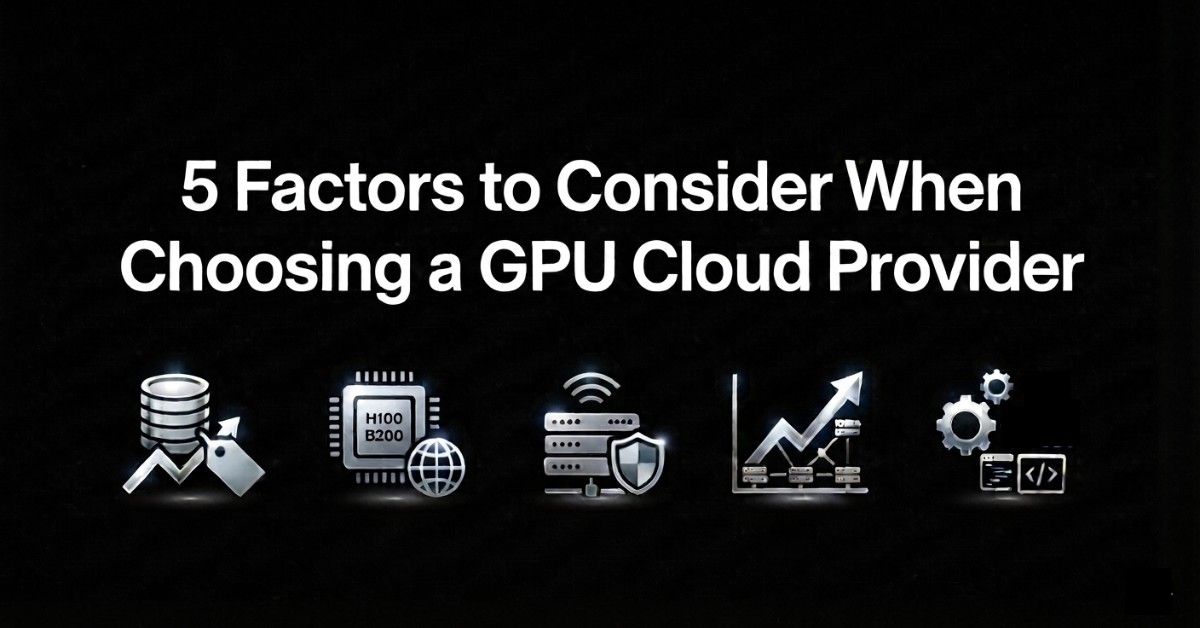


5 Factors to Consider When Choosing a GPU Cloud Provider
Selecting the best GPU cloud provider is a crucial decision that will help in determining the success of your AI project. As the demand for powerful computers increases, depending only on price can cause unexpected costs or slowdowns in performance. This guide breaks down the five essential factors you must evaluate to ensure your infrastructure scales effectively.
Why Not All GPU Cloud Providers Are the Same
Many teams mistakenly pick a GPU cloud services provider based only on the lowest hourly price. Cloud computing involves more than costs; there is also the issue of hardware access, latency in data transmission, and other forms of support.
- Contract Terms: Not all providers provide flexible monthly billing.
- Hardware Access: Some suppliers' GPUs are older generations and hence may not be compatible with your specific AI platform.
- Support Quality: When faced with configuration issues and infrastructure glitches, bad technical support can delay the process.
Factor 1: Pricing Structure and Hidden Costs
When you are vetting a service, you must look beyond the initial headline rate. Many companies use aggressive marketing to hide the true cost of operating their training runs.
- Egress Fees: Find out if the service charges you for moving data out of their cloud. These fees can be very high for AI models.
- Reserved vs On-Demand: Learn about the different discounts you can get for using a service for a long time instead of paying by the hour.
- Minimum Commitments: Make sure to find out if any minimum requirements for your account that could result in penalties if you don’t use it much during testing.
Factor 2: Hardware Availability and Infrastructure Reliability
As a premier GPU infrastructure provider, we understand the frustration of hardware shortages. Your project won't proceed if you can't receive the chips you need when you need them.
- Capacity Guarantees: For your long-term training requirements, find out if the provider can reserve clusters.
- Hardware Modernity: Make sure that they have modern GPUs (H100s/B200s) available to get the best out of your computing power.
- Location of the Data Center: Latency matters because of location; find out where their data centers are located compared to your sources of data.
Factor 3: Uptime, Support, and SLAs
Training large models requires several days or even weeks. Should a server go down during the process and they don’t have a failover policy, you would waste many hours of computation and valuable time on development.
- Failover Policies: Ask about automatic failover and how they handle your state data in case of unexpected server crashes.
- Support Responsiveness: Try testing the responsiveness of their support team by asking some technical questions in advance.
- SLA Transparency: Check their Service Level Agreement to see the uptime promises and what happens if they don't meet those promises.
Factor 4: Scalability of the Platform
Your cloud GPU computing setup should change as your project goes from research to full production. Rigid platforms often make you completely redo everything when you want to expand.
- Multi-Node Capabilities: Ensure that there is an easy way to cluster your GPUs to enable faster parallel processing.
- Infrastructure as Code: Consider platforms that support automatic scaling, which helps your clusters scale based on the current workload.
- Deployment Speed: Figure out how long it takes for a new cluster or instance to become available to you without waiting for days.
Factor 5: Ecosystem and Stack Fit
A GPU cloud platform works well only if it connects easily with the tools you already use for development. If the provider has a special system that you can't change, you might find it difficult to use your own model designs.
- Framework Compatibility: Verify that the platform works with the tools your team uses, like PyTorch, JAX, or TensorFlow.
- API/SDK Accessibility: Find good guides that help your developers work with the system using code.
- MLOps Integration: Make sure the platform works well with the tools your team already uses to keep track of experiments and handle deployments.
Why Teams Are Choosing AITECH Cloud Network
AITECH Cloud Network bridges the gap between raw compute and production-ready AI. We focus on providing the infrastructure backbone that teams need to succeed in a competitive landscape.
- Transparent Pricing: No surprise egress fees or hidden service costs.
- Scalable Architecture: Made to support your growth from small tests to large setups with many nodes.
- AI-Native Focus: We design our systems to help with the training and use of advanced AI tasks.
Conclusion
The strength and speed of your AI work rely on the tools and systems you pick now. Instead of just comparing prices, focusing on the reliability of hardware, how well it can grow, and how well it works with other systems will help your team keep making progress. Choose a partner who sees your computing needs as very important, so your project is always prepared for launch and can grow in the future.
As your trusted GPU Cloud Provider, AITECH Cloud Network delivers high-performance compute at transparent prices, driving AI success.
FAQs
1. What should you consider when choosing a GPU cloud provider?
Consider pricing transparency, hardware availability, SLA guarantees, scalability, and integration with your existing MLOps tools.
2. Which features are most important in a GPU cloud service?
Multi-node scaling, modern GPU access (H100/H200), and automated failover policies are essential for production.
3. Why is scalability important when selecting a GPU cloud provider?
It prevents costly infrastructure rebuilds as your project moves from research to large-scale production deployment.
4. Which GPU cloud provider is best for AI workloads?
Providers like AITECH Cloud Network are optimized for AI-native infrastructure, agent orchestration, and enterprise-grade performance.


344.svg)