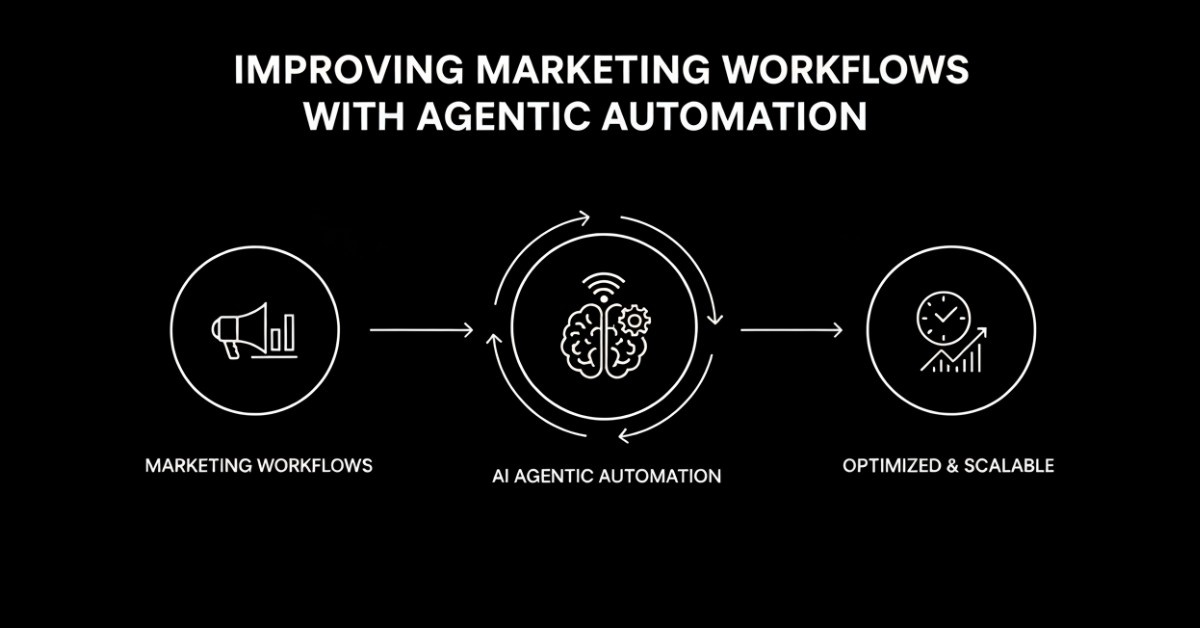


Improving Marketing Workflows with Agentic Automation
Marketing has changed from using manual tools to focusing on achieving big results. Static automation is not enough anymore to keep up with fast changes in the market. Through the use of highly agentic automation, AITECH Cloud Network helps teams step into an arena where machine thinking and decision-making are key components. This shift allows marketers to focus more on the planning process and creation of concepts, as opposed to the difficult task of project execution.
Why Marketing Teams Are Adopting Agentic Automation in 2026
Currently, marketing teams are leaning towards smart automation in efforts to enhance efficiency. Marketers are now focusing on results instead of just handling tools.
- Time Recovery: Teams save over 20 hours each week by handing off repetitive data work.
- Autonomous Reasoning: AI automation agents understand goals instead of just following strict "if-then" rules.
- Scalability: Systems utilizing agentic automation in marketing can manage large marketing tasks without needing to hire more people.
- Adaptive Learning: The artificial intelligence gets better with each campaign, improving its own plan through marketing automation with AI.
What Is Agentic Automation? (And How It Differs)
Understanding the transition depends on comprehending the way each system processes information. This is where the difference between the self-regulating device and the other device that needs regulating comes about, especially in agentic automation in marketing.
- Goal-oriented: Rather than performing a basic task such as writing an email, the focus shifts to getting a certain outcome, for example, "Generating 50 leads."
- Dynamic Adapting: The system is able to adapt to new trends in the market without any human coding, a hallmark of agentic automation in marketing.
- End-to-End Execution: AI agents for marketing workflows can perform actions across platforms such as CRM and social media independently through an AI agent orchestration layer.
- Beyond RPA: Goes beyond basic "copy-paste" jobs into more complicated tasks that involve smart computer thinking powered by AI automation agents.
5 Marketing Workflows AI Agents Are Already Transforming
Using AI tools in marketing gives quick returns on investment. This is where using marketing automation with AI is having the greatest effect, especially with AI agents for marketing workflows.
Agentic Automation vs. Traditional Marketing Automation
The gap between old-school tools and modern agentic automation comes down to reasoning. Traditional marketing automation with AI is often just "intelligent routing," whereas agentic automation provides a closed-loop system for marketing workflows through an AI agent orchestration layer.
While traditional tools require you to update your strategy manually, marketing automation with AI, based on agentic automation in marketing, adjusts the strategy for you based on live performance data.
How to Implement AI Agents in Your Marketing Stack
Smart automation in marketing can be implemented in stages, starting from the identification of your primary challenges.
- Identify Friction: Create a list of marketing activities requiring high involvement using AI automation agents.
- Define Guardrails: Establish your standards for the aesthetic look, budget, and voice of your AI automation assistants.
- Connect Your Stack: Use AITECH Cloud Network to bridge your CRM, email, and analytics platforms.
- Launch & Monitor: Let the agents operate in "watch" mode before giving them full control with AI agents for marketing workflows.
- Audit Results: Shift from controlling small tasks to checking overall progress every month using AI automation agents.
Conclusion
The shift to agentic automation is a big change for the industry. By shifting from strict processes to AI agents for marketing workflows focused on goals, marketing teams are achieving new levels of efficiency and accuracy. Adopting these self-operating systems through AITECH Cloud Network ensures your brand remains agile, scalable, and dominant in an AI-driven future.
AITECH Cloud Network delivers agentic automation that autonomously executes, optimizes, and scales marketing workflows end-to-end efficiently.
FAQs
1. What is agentic automation in marketing?
Self-driving AI systems that think for themselves to reach certain marketing goals and carry out tasks.
2. How does agentic AI improve marketing workflows?
It handles everything from start to finish on different platforms, adjusting to changes in data automatically without needing manual work.
3. What are the benefits of using AI agents in marketing?
Teams save a lot of time, work better to produce more, and develop flexible plans to reach their goals.
4. How can marketers automate campaigns using AI?
By setting clear goals and guidelines for agents to handle money, creativity, and distribution.
5. What tools support agentic automation in marketing?
AITECH Cloud Network offers the basic setup needed to link tools and use smart AI marketing agents.


344.svg)