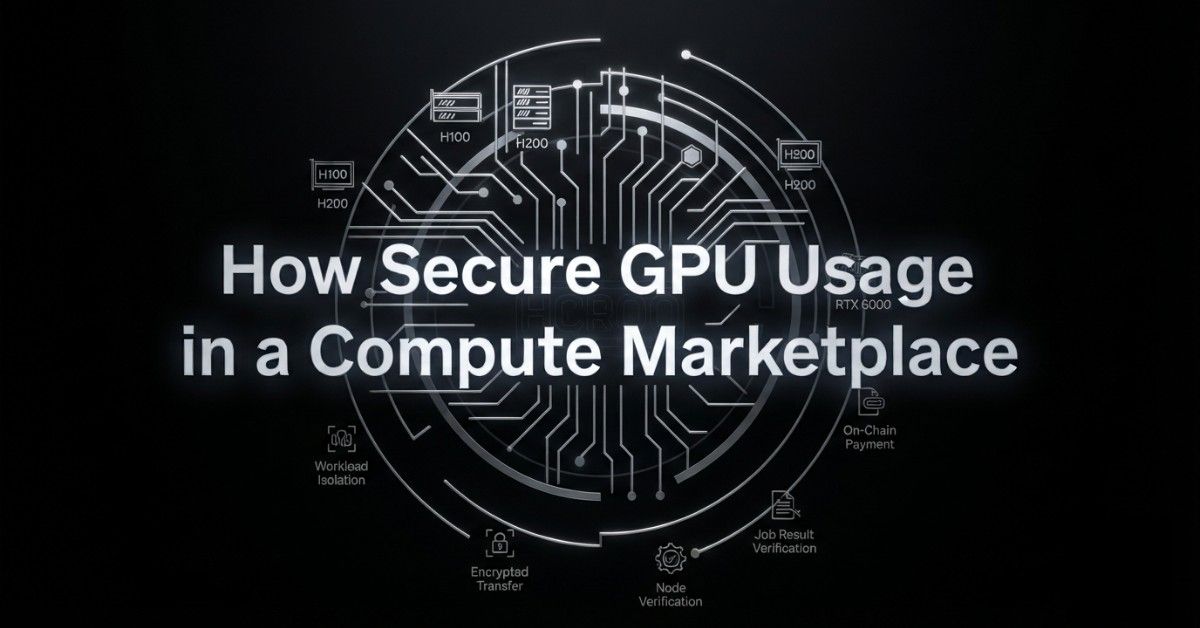


How Secure GPU Usage Works in a Compute Marketplace
Using decentralized GPU marketplaces is important for growing AI, but it requires strong security. AITECH Cloud Network keeps your private models and important data safe and secure in a shared system by using trustworthy, layered protections. By integrating advanced workload isolation, rigorous node verification, and cryptographic proofs, we provide the secure GPU usage necessary for enterprise-level deployments.
Why Secure GPU Usage Matters
AI teams renting hardware from strangers need proof that isolation is what keeps a job safe. As proprietary model weights and sensitive datasets become the backbone of modern business, relying on "blind trust" is no longer an option.
- Proprietary Protection: Models and data are your most valuable assets; they require strict environment-level security.
- Decentralized Risks: Since you don’t own the hardware, you must verify the security posture of the infrastructure provider.
- Zero-Trust Mandate: AITECH Cloud Network treats every node as potentially untrusted, requiring constant verification of the job, the hardware, and the execution integrity.
What Is a GPU Compute Marketplace
A compute marketplace is a coordination layer that matches idle GPU supply with high-demand AI workloads. It effectively decentralizes the cloud by letting people with extra hardware rent it to users all over the world.
- Aggregated Power: It links users to H100s, H200s, and RTX-class computers without needing a main data center.
- Dynamic Matching: The system smartly finds the best computer to match your job needs, like cost, availability, and computing power.
- Efficiency: It separates the orchestration of resources from the ownership of the hardware, which is why GPU compute marketplace security is critical for maintaining data integrity.
The 5 Layers of Secure GPU Usage
Achieving secure GPU computing requires a multi-faceted approach. We defend your data through these five essential layers:
How AITECH Cloud Network Secures Every GPU Job
We prioritize cloud GPU security by assuming that the hardware owner should never have access to your workload. Our architecture ensures that your code stays private and your results remain verified.
- Hardened Containers: Each task is kept separate in its own container, which stops anyone from accessing your processes on the main system.
- Strict Vetting: We only choose dependable and high-quality hardware for our network, from L40s to H200s.
- Transparent Metering: Our dashboard provides clear insights into job status, ensuring you have total visibility into your compute consumption.
- Verification-First: We replace "trust" with math; if a job isn't completed to spec, the settlement is withheld.
Secure GPU Usage vs Traditional Cloud Security
Common Security Risks in Shared GPU Environments
When renting shared hardware, certain risks are inherent. We work hard to reduce these risks using technical tools made for decentralized systems.
- Data Leakage: Reduced by using strong separation of containers or virtual machines (VMs) to stop one user from accessing another user's information.
- Malicious Nodes: Handled by a reputation scoring system that removes unreliable or underperforming nodes from our pool.
- Output Tampering: Solved through redundant execution checks that confirm the integrity of your AI model's results.
- Latency Issues: Handled by built-in retry and checkpointing logic that ensures your long-running training jobs don't fail due to minor network shifts.
Compliance and Data Privacy in a GPU Compute Marketplace
For companies in regulated fields, data privacy is the top priority. While our infrastructure provides secure AI compute, we also empower you to audit your own usage.
- Audit Readiness: Our transparency dashboard lets you track your computing history clearly, making it easier to follow rules and regulations.
- Encryption Standards: We use strong encryption to protect all data being sent so that only the intended people can read it, keeping private information safe from others.
- Hybrid Flexibility: We recommend that highly regulated workloads utilize a hybrid strategy, leveraging the GPU marketplace security features for high-performance training while keeping sensitive local data behind your own firewall.
How to Evaluate a Secure AI Compute Provider
Picking the best partner for your AI setup is an important choice. Always choose services that focus on checking things carefully rather than just making it easy.
- Check for Isolation: Verify that the platform uses per-job containerization rather than simple shared-perimeter access.
- Verify Execution: Look for clear mechanisms like reputation scores or redundant job checks.
- Assess Settlement: Confirm that payments are automated and auditable through smart contracts.
- Audit Vetting: Ask how the platform qualifies the nodes that host your expensive AI jobs.
Getting Started with AITECH Cloud Network
Are you ready to use your first job on a safe and fast network?
- Explore: Check out our dashboard to see the available GPU nodes, such as H100s, H200s, and RTX 6000s.
- Deploy: Start your container job easily with tracking already set up.
- Pay: Experience transparent, per-job settlement using $ACN tokens.
Conclusion
Securing GPU usage in a decentralized marketplace is no longer a trade-off between performance and safety. By adopting AITECH Cloud Network’s verification-first architecture, you regain control over your AI infrastructure. Protect your assets, verify every execution, and scale your innovations with the confidence that your compute environment is fundamentally secure.
AITECH Cloud Network secures your AI assets through rigorous, verification-first architecture, ensuring private, high-performance compute on decentralized hardware.
FAQs
1. How does secure GPU usage work in a compute marketplace?
It uses workload isolation, node vetting, and cryptographic proofs instead of blind trust.
2. How are GPU workloads protected in a compute marketplace?
Tasks run in separate, secure containers, stopping anyone from getting unauthorized access to the main system.
3. What security features should a GPU marketplace provide?
Look for per-job containerization, node reputation systems, and automated, verifiable smart-contract settlements.
4. Is it safe to run AI workloads on rented GPU resources?
Yes, if the provider uses verified, zero-trust architectures for job execution.
5. How do compute marketplaces protect user data and models?
Through end-to-end encryption, strict container isolation, and redundant execution verification checks.
6. What best practices support secure GPU computing?
Use audit-ready dashboards, implement hybrid cloud strategies, and prioritize hardware-level attestation.


344.svg)