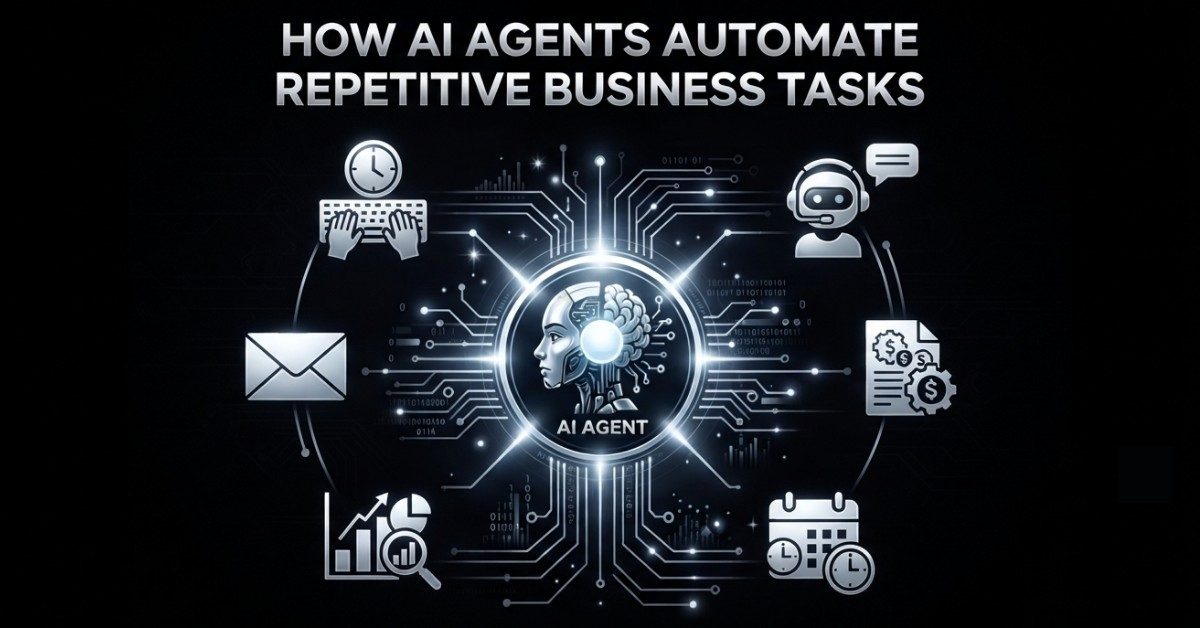


How AI Agents Automate Repetitive Business Tasks
Teams spend up to 40% of their work time on manual tasks, which demotivates employees. Deploying AI agents for repetitive business tasks removes such operational bottlenecks and takes businesses beyond linear scalability problems. Modern automation helps in saving the energy of employees continuously, thereby providing talented professionals the opportunity to devote all their energy toward creative thinking and strategic planning.
Why Repetitive Tasks Are Costing Businesses More Than They Realize
Manual entry of data, replying to endless emails, creating reports, and playing calendar Tetris slowly waste thousands of man-hours that ought to be spent elsewhere. When skilled people lose half a working day shuffling numbers from one spreadsheet to another or following approval processes, the momentum is broken.
- Bottlenecks cluster predictably: Support queues are overflowing, invoices need approvals, and onboarding tasks are awaiting in full inboxes.
- Linear scaling fails: Hiring more staff to manage the regular workload is costly, makes training slower, and doesn't fix the underlying issues.
- Burnout accelerates: Talented team members leave when their workday is filled with boring tasks instead of interesting jobs.
Effective repetitive task automation changes everything completely. By putting AI agents to work on predictable operational burdens, business automation protects employee energy while keeping internal processes moving around the clock.
What Makes AI Agents Different from Traditional Automation
Traditional tools like rigid macros or legacy robotic process automation (RPA) follow strict, brittle if-then rules. The second an input changes format or a customer spells a name differently, the script crashes, leaving a human to clean up the mess.
- Context over code: AI agents make sense of everyday language, messy information, and complicated details before figuring out what to do.
- Collaborative Execution: They can easily integrate with several enterprise platforms as well as communicate with other agents to perform multi-step workflows.
- Assistant analogy: While traditional automation technologies resemble a vending machine that will give you a snack only if you push the correct button, an AI agent will be more like an experienced assistant who will know what you mean and how to achieve your goal.
Deploying AI agents to automate businesses provides organizations with the flexibility necessary to deal with the complexity of the real world.
Quick Overview: Business Functions AI Agents Automate Best
Implementing AI automation for repetitive tasks changes how departments manage large amounts of work. AI agents can understand the situation, so they work well in many areas of business, making tasks easier without needing constant human control.
Customer Service & Email: Automating Routine Conversations
Customer support queues and overflowing email inboxes are the biggest challenges for today’s service teams. Today’s AI tools can handle simple, repetitive tasks by working directly through chat, email, and voice systems. They help manage a lot of interactions efficiently.
- Maintained context: Unlike simple chatbots that forget what was said after a couple of messages, modern chatbots remember the whole chat and use real product information to give correct answers.
- Smart escalation: If a question is too emotional or too complicated, the agent quickly passes it to a human expert, along with a full summary of the issue.
- Starting point: This function remains the absolute best starting point for teams testing AI capabilities for the first time.
Document Processing & Data Entry: Eliminating Manual Work
Finance, operations, and support teams waste a lot of time typing numbers from PDF invoices, scanned contracts, and messy forms into their computer systems.
- Unstructured data extraction: Agents gather important information from documents that have no specific format, no matter how they are arranged.
- Automated validation: They check line items against existing purchase orders, flag anomalies, and route valid data directly into target databases.
- Error elimination: Removing manual re-typing eliminates the root cause of costly transcription mistakes.
Teams implementing repetitive task automation in their back-office report immediate turnaround improvements and dramatic drops in processing overhead.
Scheduling & Workflow Orchestration: Coordinating the Busywork
Scheduling meetings involving multiple calendars, different time zones, and varying priorities is just additional overhead. The role of scheduling agents is to take away the hassle from the process of scheduling by communicating directly with invitees and locking in a good meeting slot right away.
- Complex orchestration: Beyond basic scheduling, workflow orchestration agents coordinate complex procedures such as employee onboarding or order fulfillment.
- Exception handling: If a step stalls, the agent marks the problem, updates the status reports, and only informs a manager if help from a person is needed.
- Operational clarity: This approach shines brightest for operations teams managing intricate, multi-layered processes.
Integrating AI agents for business automation across your operational pipelines cuts project completion times significantly while keeping business automation running smoothly behind the scenes.
AI Agents vs Traditional Automation: Real Cost & ROI
Evaluating whether to invest in AI agents for repetitive business tasks comes down to looking closely at flexibility, maintenance costs, and ultimate return on investment.
Most organizations see clear improvements in performance within 2 to 8 weeks after starting a new system. Financial gains come directly from saving time, making almost no mistakes, responding to customers quickly, and being able to increase production without hiring more people.
How to Get Started with AI Agents for Business Automation
AI automation for repetitive tasks need not involve an instantaneous or wholesale transformation of the entire company. A phased implementation approach is less disruptive and more convincing.
- Pick one target: Select a single volume process that requires less judgment, such as email filtering, first-level data entry, and calendar scheduling.
- Establish baselines: Set the performance benchmarks of your processes before rolling out, measuring the time taken per process and errors made.
- Verify integrations: Verify that the bots you have selected integrate simply with your existing CRM and communication systems.
- Design human guardrails: Create human decision-making oversight systems where needed.
- Scale deliberately: Show that your first agent is really useful before spreading it to other teams.
Conclusion
By removing regular administrative tasks from human teams, modern businesses become much more flexible and can grow consistently. Operational excellence does not rely on simply hiring more workers. This lets organizations move past old limitations and concentrate fully on making impactful innovations.
FAQs
1. How do AI agents automate repetitive business tasks?
By processing context, unstructured data, and cross-system workflows autonomously around the clock.
2. What business tasks can AI agents automate?
Customer service, document processing, email triage, calendar scheduling, and cross-system data entry.
3. How can AI agents reduce repetitive work?
By eliminating manual data retyping, resolving routine inquiries, and managing multi-step operational handoffs.
4. What are the benefits of automating repetitive business tasks?
Higher productivity, reduced errors, faster cycle times, lower overhead, and diminished employee burnout.
5. Which businesses benefit most from AI task automation?
Companies with heavy back-office administration, high-volume customer support, and manual document processing benefit most.
6. How do AI agents improve productivity and workflow efficiency?
By running 24/7, handling complex exception cases, and freeing teams for high-level strategy.


344.svg)